This is the latest installment in Nicolai Ouroussoff's architectural tour of Europe and Russia. It is an attempt to enter the debate on the value of brutalist architecture which dominated in the post-war era and which I most associate with Boston City Hall in the United States. Le Courboussier's design for Chandigarh and Oscar Niemeyer's for Brasilia are also often exhibits in the case against this thread of modernism.
Ouroussoff does a nice job balancing between the different camps in his description of Robin Hood Gardens in London. For example, the small detail that the architects shortened one of the two buildings to bring in more southern light is important and inspired. Also, the gentle bend of both buildings is quite beautiful. But the physical and social isolation and lack of public safety are familiar to anyone who has read about, visited, or lived in public housing towers in the U.S.
These conditions are not a necessary consequence of the architecture but the result of lack of money, opportunity, and hope. While I am usually sympathetic to explanations that feature externally imposed structural constraints on people just trying to survive, the critics of brutalist architecture focus on the wrong structure. It is the society -- not the buildings -- that chooses to warehouse poor people in public housing, overcrowded schools, and prisons.
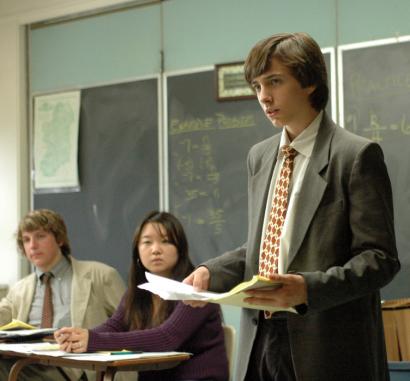
My friend Rick recently posted on a week from our high school days when we spent time in Chicago between debate tournaments at the Glenbrook high schools. I read his post and remembered some things similarly and other things differently. It made me think about memory and affect and how we each tell stories from our lives. Here are some of my reflections on that week:
My cousin Bimal was generous in allowing us to stay in his dorm basement and gave us the box on which we played Led Zeppelin. But the room was windowless and had the distinct odor of celery, probably from the industrial carpet on which we slept.
Our four sleeping bags filled the entire little room. Rick was (and is) funny as hell but often made jokes at the expense of his slower, less clever friends (we were all his straight men, basically). As a result, Rich, Bob, and I would periodically attack him on the sleeping bags, getting back at him for all of the clever funniness that we had borne for the prior three and a half years of long trips in the school van. Rick would say something clever and annoying and one of us would yell, GET HIM, and we’d pounce. It was great fun.
Rick and I felt we were on the cusp of being one of the better high school debate teams in the country, but I think we both understood that we had not broken through when we needed to perform. There was that debacle at the end of my junior year that Rick mentions in his post, as well as other times when we dropped an elimination round too easily. We went 6-0 at Bronx Science our senior year and lost to an excellent team from Texas in double-octafinals. We dropped in the first elimination round at the Tournament of Champions in Kentucky (a lot of the structure of our competition was based on college sports, which I didn't understand then). We went quietly our junior and senior years at the Harvard tournament, as far as I can remember. We beat our intra-district rival, Hen Hud, with some regularity, but did not overcome the best team in the state, Stuyvesant, until Catholic Nationals our senior year. That was one tournament at which we finally fulfilled our potential in the semifinal round, though even then we lost to a talented but not overwhelming team from Chicago helmed by a now-famous law professor and Supreme Court lawyer in the finals. At the first Glenbrook tournament, we came close to beating a great team from Westminster in the quarterfinals with a “disadvantage” that we had created but were stymied by a missing piece of evidence in the “link” section of the argument. We spent some time in the main Northwestern library that week searching for it, but could not substantiate the argument. That missing evidence stands out to me as emblematic of our standing in the debate world and our inability to make the necessary breakthroughs.
We didn’t drop a ballot at the Lexington tournament after we were ignored by the Harvard Roundrobin selectors, but unlike Rick I don’t remember beating two roundrobin teams there. No great teams were competing at Lex and we won the final round against the junior team from another intra-district rival, Edgemont. We had great expectations for the National Tournament held in Cincinnati, Ohio in June of our senior year (and passed up the prom for it, though that was a fine decision in light of what I now know about proms) but once again went quietly and did not make it far into the tournament. Rick had a lot of fun there with friends from other schools in the “Holidome” Holiday Inn where we were staying and I went to King’s Island and rode roller coasters with my debate coach.
The future law professor from Chicago, his friend from Manchester, Massachusetts who won the National tournament, and our intra-state rivals at Stuyvesant had an intangible drive to win and maybe were just brighter than we were. It makes me wonder about where we came from, our family backgrounds, and our schools. There were teams just before and just after us at Lakeland who made it on the roundrobin circuit, so the social inequality explanation probably does not fly. Rick and I happened to be the best team in our class at Lakeland but I'm not sure that we shared the drive that other teams had on the circuit.
I have debate dreams with some regularity. I am competing again, given the chance to go back in time and make up for lost opportunities. It’s telling that I also have law school dreams, when I think of making up for those lost opportunities. In these time machine dreams my stomach clenches as I recall the anxiety of competition. In my waking life, I wonder how I could have spent so many weekends in my high school years with that stomach-clenching feeling before every debate round and at every elimination tournament. The way I remember those years may be a product of how Rick and I approach our lives. I tend to tell stories about myself with a decidedly negative, self-critical slant, as evidenced on this blog. Rick tells stories differently, though he has confronted sadness and uncertainty in his own life. I think he is probably a happier, more generative person than I am and I'm thankful for his continued friendship, especially because in my early adulthood I have been drawn more to friends like myself who tell stories and remember life episodes in a minor key.
One last memory from the celery room. Before I left, I had asked out a girl who was also on the debate team. She had said yes and we were going to go out when we got back from Chicago. She was my first girlfriend. I wore her scarf in Chicago and it smelled of the girlish perfume that she used. I also copied the lyric sheet from the record sleeve of the Peter Gabriel album So for the song In Your Eyes. I did that before Say Anything was a glimmer in the eye of Cameron Crowe. I was a happy guy that week. I don't dream about that part of my adolescence, meeting a girl who loved Ronald Reagan and wearing her scarf. But that thread of the reality of those years may fill out my memory: friendship, pre-college quirk, regular escape from soul-killing suburbia, and, yes, even some competitive success.
I saw Pearl Jam twice on their 2000 tour, on August 24 at Jones Beach and then a week later in Camden, New Jersey. It was a tough tour for the band. Nine members of the audience died during their performance at the Roskilde Festival in Denmark and Ed Vedder’s marriage broke down just after Binaural was finished and the tour started (on the basis of things he’s said in the years since). My girlfriend at the time (“GF”) thought that Ed looked like Jesus Christ, which is highly ironic in light of his “I’m no messiah” complex. It is true that he looked thin and ravaged when we saw the band at Jones Beach. The show was less about joy and defiance than mere survival. (I know this may sound over-the-top but we Pearl Jam fans take such things seriously.) At a key moment, as the band segued out of Daughter, Ed picked up a piece of paper and told the audience that he had a part for us. He started singing the words to a song by the Portland band Dead Moon and we echoed during the chorus:
it's okay, you don't have to run and hide away it's okay, i love you anyway it's okay, you don't have to run and hide away it's okay... this is my chance, this is my life this is my hope in an alleyway this is my choice, this is my voice there may be no tomorrow, now this is my plea, this is my need this is my time for standing free this is my staff, this is my day and the world is never safe it's okay, you know i love you anyway it's okay, you don't have to run and hide away it's okay, it's okay it's okay...
You can see what we saw that night (the turn to It’s Okay takes place at 4:02):
GF and I had taken a break in our year and half old relationship that August. I had told a mutual friend that I would be proposing to her in January, but that moment had passed and I resisted the relationship on the rationale that we fought too much. We did fight, on street corners, in apartment stairwells and cars. After one particularly bad fight when she was threatening to leave my apartment at 2 a.m. and I was yelling in that stairwell, I wondered what I had become. I kept repeating lines from Springsteen’s “One Step Up” to myself:
Another fight and I slam the door on Another battle in our dirty little war When I look at myself I don't see The man I wanted to be Somewhere along the line I slipped off track
Of course, I loved her deeply and she made me very happy. I have a picture of us at a diner with out-of-town friends the morning after my thirtieth birthday party. I loved her so much that morning and I was holding onto her so tightly that she had to tell me to loosen my arms around her. She had gotten me to invite all of my friends to a dinner and assembled a book of their contributions in my honor. They had made pages of words, photos and drawings for me. It’s the kind of moment that might occur maybe two or three times in your life, if you’re lucky.
When I think back to that relationship, I always remember taking GF to those Pearl Jam shows and I cringe at the memory. She was still so in love with me, even as I expressed hesitation and asked for “time off” from the relationship. She put up with the conditions of a Pearl Jam concert: lots of white male teenagers drinking beer and wondering loudly how they could approximate the spirited moshing of a past half-generation from the Evenflow and Alive videos. We got free tickets to the Philadelphia show by walking around the venue to register new voters. GF gamely tried to register these sloshed kids and when we got our tickets sat down heavily in the midst of the crowd, tired from our interactions with the drunken masses.
When I mentioned this episode to her during a phone conversation a few years after we had broken up, she told me to forget about it. She had moved on (and now has a husband and daughter) but I was holding on to the memories. I had met an amazing woman on a trip to the west coast a few months earlier, someone who I thought might make me very happy, and perhaps I was pleading for release. When I told GF that I needed her forgiveness, my voice broke and I started sobbing on the phone. She said to me, you need to forgive yourself.
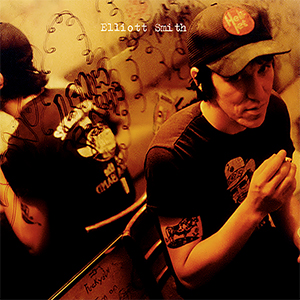
I learned today that the Elliott Smith record is inspired by a book of essays of the same name by Soren Kierkegaard. Apparently, Kierkegaard set out the stages of existence and contrasts a life of aesthetic pursuit with one of ethical commitment. I came upon all of this information while doing internet searches related to Walker Percy's The Moviegoer, which is one of my favorite novels. Percy created his narrative after reading Either/Or and the passage from empty pursuit to commitment is a compelling framework for his story (and that of many others to which I am drawn, including High Fidelity and Sideways).
Why was I Googling The Moviegoer? Because I am having a particularly empty day, wasted morning, wandering my neighborhood, ending at a cafe where I sit and surf while another draft of my article is due to my bosses at work. This follows a phone conversation last night with one of my best friends (with whom I share a general career trajectory) during which we discussed (1) his recent triumphant speech to an audience of public interest lawyers and his stunned mother, (2) his upcoming sabbatical leave, the second in three years, (3) his litigation on behalf of a detainee at Guantanamo, and (4) my recent withdrawal from a conference in Berlin in July on the advice of the aforementioned bosses. He is a good man and a good friend, as close as a brother to me in many respects, but I can't help but be depressed after we speak on the phone. So I awoke in a hole and I stay bored and listless, unable to engage with the work that I must do. I think of alternate careers and (laughably) curse my own freedom to write at a cafe.
Plane tickets and hotel reservations for Berlin are cancelled. I withdraw from the panels on which I was to speak. After (1) being one of three people in a group of twenty at a conference not to be selected for publication in a book two years ago, (2) being passed over for consideration for a higher position in my workplace, (3) watching friends with my qualifications make more money and acquire greater purpose and focus as they age, and (4) having close friends be surprised when I am selected for some honor, such as a speaking role in a graduation ceremony, I wonder when the indignities will cease. My aspiration for a life of ethical commitment remains out of my grasp because of the life preferences of my partner and the simultaneously purpose-killing structurelessness and imprisonment of my work as currently constructed. Others tell me how good I have it and to remain in pursuit of their goals. I want to not wake up in the morning.
Powerful trailer for a new documentary called Body of War, with songs by Eddie Vedder. A live performance of the song No More is here, but the images from the movie in the trailer are much more affecting than seeing Eddie on stage.
Not even ending up as a Microsoft commercial theme could quench the sheer power and beauty of "Heroes," arguably David Bowie's finest individual song throughout his varied, fascinating career. The story of its inspiration got a bit muddled over time -- it might have been two employees at the recording studio near the Berlin Wall who Bowie saw in an embrace, or simply two random strangers in the shadow of that Cold War symbol. But inspired by that and with the collaborative help of Brian Eno and, with a jaw-dropping set of solos, guitarist Robert Fripp, Bowie, his backing band and producer Tony Visconti created a true classic. Clearly drawing from the various German influences he had absorbed while still relying on the dramatic power of rock and roll, the song becomes an anthem, Fripp's exquisite work at once celebratory and an electric requiem. That feeling of valediction is reflected in Bowie's lyric about individual connection and response in the face of a crushing, anonymous outside world -- but it wouldn't be half so grand without Bowie's simply breathtaking vocal. Starting with an almost conversational tone, by the end of the song he's turning in a performance that could almost be called operatic, yet still achingly, passionately human.
A Sonata for a Good Man and Woman. When I go to Berlin this summer, I aim to visit the Stasi detention center shown in The Lives of Others as well as the Hansa Ton Studio where Bowie recorded his Berlin trilogy with Brian Eno and Tony Visconti and where U2 recorded parts of Achtung Baby with Eno and Daniel Lanois. Bowie was rooming with Iggy Pop and trying to overcome a cocaine addiction in Berlin; U2 nearly broke up because of artistic differences before writing One together. Fascinating (though, of course, not intended to trivialize the savage political history of the place and time).
Pitchfork’s Rob Mitchum minces the new Wilco record, Sky Blue Sky, and calls it “dad-rock.” A sentence from the review:
Case in point, the drowsy opener "Either Way" sleepwalks through a list of indecisive sentiments ("maybe you love me, maybe you don't") before breaking for a Cline solo that's straight-up Weather Channel Local on the 8s.
Maybe the sun will shine today The clouds will blow away Maybe I won’t feel so afraid I will try to understand Either way
Maybe you still love me Maybe you don’t Either you will or you won’t Maybe you just need some time alone I will try to understand Everything has its plan Either way I’m gonna stay Right for you
Maybe the sun will shine today The clouds will roll away Maybe I won’t be so afraid I will understand everything has its plan Either way
It’s not Dylanesque poetry but even on the page, those lyrics are something more than a list of indecisive sentiments. Anyone who follows the band, even loosely, knows that a large percentage of the songs on the last four Wilco albums concern Jeff Tweedy’s sometimes quite frayed relationship with his wife (and more generally, with anyone outside of his alienated self). It’s possible that that knowledge is required in imbuing the lyrics to Either Way with a greater meaning than Mitchum recognizes. But if you listen to the song, it sounds like a prayer: for the sun to shine, for fear to abate, for greater understanding of your self and your place in the world (best analogue in the Pearl Jam song catalogue: Sometimes on No Code, also an album opener). It’s in the way Tweedy sings it, with a question and a catch in his voice in every line and with hope for self-knowledge. “Maybe you just need some time alone” suggests trepidation and a situation just about spun out of control. The tentative resolve is more meaningful in light of this sense of genuine risk.
Either Way is not even one of my favorites on SBS and I still see in it much more than indecisive sentiments. This may be a result of the compact struck between artist and fan, the agreement that they will do their expressive best and we will give full faith and credit to each of their paintings or chapters or songs. (No one pays me to pick apart music, so I can speak as a member of the flock rather than as a theologian.) It strikes me however that the banality to which Mitchum alludes is a fundamental attribute of popular music when words and lines are read in isolation and apart from the context of the songwriter’s and listener's life and passion. It is roughly analogous to judges like Antonin Scalia who (sometimes, when it fits their ends) seek to read legal language in “plain text” rather than finding meaning in the words through a broader reading of the historical moment in which a statute was first passed and adapted to fit the current context. It feels to me like a lazy or ends-oriented approach to both law and music criticism, rather than a genuine attempt to engage with the text. Mitchum wanted to find that Sky Blue Sky is dad-rock so he lifted a few lines from the first song and made light of their banality.
In the commentary track to Moulin Rouge, I believe during the Elephant Medley (one of my favorite movie scenes of all-time), Baz Luhrman talks about how music transforms words into poetry. He’s right, of course, and that’s why the film makes such splendid use of modern pop music. Another film more centrally about music that I just saw earlier tonight, Once, has a humorous scene in which the male protagonist strums and sings his romantic history to the female lead on the back of a bus. It is genius because the history is at once banal (his girlfriend cheated on him) but incredibly meaningful for these two people falling for each other. And singing the words allows the cynical, lonely singer-songwriter to add underlying emotional depth, to express how he feels and to connect with this lovely new woman who has come into his life. Allof the songs in Once have this quality and provide a rationale for an otherwise questionably fast melding of interests and understandings between the two leads.
The transformation of plain words into something much more profound and connective is magical, alchemical, two separate acts of faith by the songwriter and the listener. It’s an essential part of what makes modern music so important to me. After all, life itself is mind-numbingly banal. It is only through magic, alchemy, and faith that we gain the fortitude to persevere.
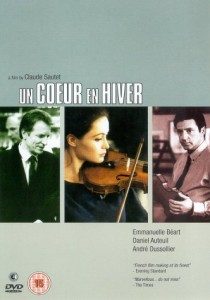
In Un Coeur En Hiver (A Heart in Winter), a violin maker played by Daniel Auteuil reaches out of his shell to draw the intense interest of a gifted young violinist played by Emmanuelle Beart. His more charismatic business partner is having an affair with her and he sees her professionally at first, at their workshop and her practices. Eventually, he finds himself hovering outside of the studio where she is recording Ravel and goes with her, through an outpouring of rain, to a cafe where he tells her that he loves to see her speak. His quiet but intense presence, ascetic and dedicated nature (he lives in a bedroom at the workshop), and interest in her is magnetic. His subsequent actions are mutedly shocking and an audience shivers at the sight of a cold heart laid bare.
There are more than a few times when I have sat in a car or at a table in a restaurant and done what this "protagonist" does to the young woman in the film. I have abandoned relationships at all points in their life cycle, from infancy to adulthood. After I have destroyed a fledgling relationship, I have been joyous and experienced the relief of freedom from a small suffocating box. In all of these relationships, there are moments of great happiness, but the imperative to break free of another and to resist the unbundling of a tight ball of emotion somewhere inside of me is too great. With loneliness comes freedom, of a particular variety, free to stay within myself and not communicate the feelings I so desperately want to submerge. I am able to act out. No one is there to push back, except my own most destructive and undermining of selves, burdening my mind with guilt and faithlessness, even as I experience my "freedom."
I think of these things in the context of my current relationship. There are days on end when I am unwilling to communicate with anyone. My commitment to solitude is my strongest quality and dates back to my earliest consciousness. The fact that I spend my time in isolation sleeping and seeking solace from television and the internet (much as Ganesh does) makes me question whether it is solitude that I defend. It seems more accurate to call it alienation, from all living people.
A merging of two people is an impossibility, and where it seems to exist, it is a hemming-in, a mutual consent that robs one party or both parties of their fullest freedom and development. But once the realization is accepted that even between the closest people infinite distances exist, a marvelous living side-by-side can grow up for them, if they succeed in loving the expanse between them, which gives them the possibility of always seeing each other as a whole and before an immense sky.
The writer and his friend have an illuminating debate about the meaning of love between two people, one arguing for Rilke's joint solitude and the other for deconstruction of the self, a merging into the other and his God. The writer concludes:
And yet, and yet. I cannot help but feel that my friend and I might have but a single conception of love. I cannot shake the suspicion that, in love's strange geometry, infinite distance and intersection are one and the same.
Each must, out of his private suffering, find the language that allows him to survive that suffering.
As I work through my feelings in my current relationship with my patient partner, I search for my own language of survival. I don't mean to elevate my "private suffering." I am privileged and empowered beyond my own belief. But I have yet to successfully negotiate a path between my solitude and my deconstruction. It is a crowded path on which I walk with many friends. In our collective search, there might exist a constitutive grammar for our language of survival.
Rage Against the Machine was just angry, and nearly all business. Back together for its first show in seven years — others are to follow, at least through this summer — it went precisely back to where it left off. Where Manu Chao was noisily border-crossing, setting off sampled sirens to suggest close-range urban bustle, Rage wants its audience to feel the fear and dread of places where the working classes die in their uniforms, and a violent urge to disobey.
Part of the band’s sound, and part of its riffs, come from the hard midtempo funk of Jimi Hendrix’s Band of Gypsies, but their songs are far more rigid in every way — feeling, design, sentiment. Given such a long layoff, the band played hard and well. Still, seven years isn’t such a long time, and all was much the same: Zack De La Rocha’s enraged whine lives intact; Tom Morello still makes his guitar rant and spit, his control over the wah-wah pedal and his guitar’s kill-switch undiminished.
The crowd bounced like springs, and yet, on another level, the music came off almost purely as a political project. Only in a version of Afrika Bambaataa’s “Renegades of Funk” — with lines like “every time I pop into the beat we get fresh” — was it clear that this was only a rock band.