Showing posts with label film. Show all posts
Showing posts with label film. Show all posts
Thursday, September 13, 2007

Thursday, May 31, 2007
Body of War

Tuesday, May 22, 2007
"Heroes" (1977)
David Bowie/Brian Eno
All Music Guide:
Not even ending up as a Microsoft commercial theme could quench the sheer power and beauty of "Heroes," arguably David Bowie's finest individual song throughout his varied, fascinating career. The story of its inspiration got a bit muddled over time -- it might have been two employees at the recording studio near the Berlin Wall who Bowie saw in an embrace, or simply two random strangers in the shadow of that Cold War symbol. But inspired by that and with the collaborative help of Brian Eno and, with a jaw-dropping set of solos, guitarist Robert Fripp, Bowie, his backing band and producer Tony Visconti created a true classic. Clearly drawing from the various German influences he had absorbed while still relying on the dramatic power of rock and roll, the song becomes an anthem, Fripp's exquisite work at once celebratory and an electric requiem. That feeling of valediction is reflected in Bowie's lyric about individual connection and response in the face of a crushing, anonymous outside world -- but it wouldn't be half so grand without Bowie's simply breathtaking vocal. Starting with an almost conversational tone, by the end of the song he's turning in a performance that could almost be called operatic, yet still achingly, passionately human.A Sonata for a Good Man and Woman. When I go to Berlin this summer, I aim to visit the Stasi detention center shown in The Lives of Others as well as the Hansa Ton Studio where Bowie recorded his Berlin trilogy with Brian Eno and Tony Visconti and where U2 recorded parts of Achtung Baby with Eno and Daniel Lanois. Bowie was rooming with Iggy Pop and trying to overcome a cocaine addiction in Berlin; U2 nearly broke up because of artistic differences before writing One together. Fascinating (though, of course, not intended to trivialize the savage political history of the place and time).
Sunday, May 20, 2007
The Banality of Song Lyrics
Pitchfork’s Rob Mitchum minces the new Wilco record, Sky Blue Sky, and calls it “dad-rock.” A sentence from the review:
Case in point, the drowsy opener "Either Way" sleepwalks through a list of indecisive sentiments ("maybe you love me, maybe you don't") before breaking for a Cline solo that's straight-up Weather Channel Local on the 8s.These are the lyrics of Either Way in their entirety:
Maybe the sun will shine todayIt’s not Dylanesque poetry but even on the page, those lyrics are something more than a list of indecisive sentiments. Anyone who follows the band, even loosely, knows that a large percentage of the songs on the last four Wilco albums concern Jeff Tweedy’s sometimes quite frayed relationship with his wife (and more generally, with anyone outside of his alienated self). It’s possible that that knowledge is required in imbuing the lyrics to Either Way with a greater meaning than Mitchum recognizes. But if you listen to the song, it sounds like a prayer: for the sun to shine, for fear to abate, for greater understanding of your self and your place in the world (best analogue in the Pearl Jam song catalogue: Sometimes on No Code, also an album opener). It’s in the way Tweedy sings it, with a question and a catch in his voice in every line and with hope for self-knowledge. “Maybe you just need some time alone” suggests trepidation and a situation just about spun out of control. The tentative resolve is more meaningful in light of this sense of genuine risk.
The clouds will blow away
Maybe I won’t feel so afraid
I will try to understand
Either way
Maybe you still love me
Maybe you don’t
Either you will or you won’t
Maybe you just need some time alone
I will try to understand
Everything has its plan
Either way
I’m gonna stay
Right for you
Maybe the sun will shine today
The clouds will roll away
Maybe I won’t be so afraid
I will understand everything has its plan
Either way
Either Way is not even one of my favorites on SBS and I still see in it much more than indecisive sentiments. This may be a result of the compact struck between artist and fan, the agreement that they will do their expressive best and we will give full faith and credit to each of their paintings or chapters or songs. (No one pays me to pick apart music, so I can speak as a member of the flock rather than as a theologian.) It strikes me however that the banality to which Mitchum alludes is a fundamental attribute of popular music when words and lines are read in isolation and apart from the context of the songwriter’s and listener's life and passion. It is roughly analogous to judges like Antonin Scalia who (sometimes, when it fits their ends) seek to read legal language in “plain text” rather than finding meaning in the words through a broader reading of the historical moment in which a statute was first passed and adapted to fit the current context. It feels to me like a lazy or ends-oriented approach to both law and music criticism, rather than a genuine attempt to engage with the text. Mitchum wanted to find that Sky Blue Sky is dad-rock so he lifted a few lines from the first song and made light of their banality.
In the commentary track to Moulin Rouge, I believe during the Elephant Medley (one of my favorite movie scenes of all-time), Baz Luhrman talks about how music transforms words into poetry. He’s right, of course, and that’s why the film makes such splendid use of modern pop music. Another film more centrally about music that I just saw earlier tonight, Once, has a humorous scene in which the male protagonist strums and sings his romantic history to the female lead on the back of a bus. It is genius because the history is at once banal (his girlfriend cheated on him) but incredibly meaningful for these two people falling for each other. And singing the words allows the cynical, lonely singer-songwriter to add underlying emotional depth, to express how he feels and to connect with this lovely new woman who has come into his life. All of the songs in Once have this quality and provide a rationale for an otherwise questionably fast melding of interests and understandings between the two leads.
The transformation of plain words into something much more profound and connective is magical, alchemical, two separate acts of faith by the songwriter and the listener. It’s an essential part of what makes modern music so important to me. After all, life itself is mind-numbingly banal. It is only through magic, alchemy, and faith that we gain the fortitude to persevere.
Monday, May 07, 2007
The Language of Survival
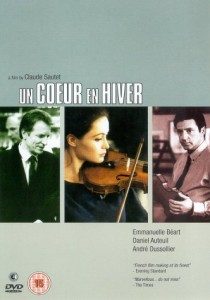
There are more than a few times when I have sat in a car or at a table in a restaurant and done what this "protagonist" does to the young woman in the film. I have abandoned relationships at all points in their life cycle, from infancy to adulthood. After I have destroyed a fledgling relationship, I have been joyous and experienced the relief of freedom from a small suffocating box. In all of these relationships, there are moments of great happiness, but the imperative to break free of another and to resist the unbundling of a tight ball of emotion somewhere inside of me is too great. With loneliness comes freedom, of a particular variety, free to stay within myself and not communicate the feelings I so desperately want to submerge. I am able to act out. No one is there to push back, except my own most destructive and undermining of selves, burdening my mind with guilt and faithlessness, even as I experience my "freedom."
I think of these things in the context of my current relationship. There are days on end when I am unwilling to communicate with anyone. My commitment to solitude is my strongest quality and dates back to my earliest consciousness. The fact that I spend my time in isolation sleeping and seeking solace from television and the internet (much as Ganesh does) makes me question whether it is solitude that I defend. It seems more accurate to call it alienation, from all living people.
There is a wonderful exchange between two friends on love and solitude at Modal Minority, stemming from a Rilke quote partially excerpted here:
A merging of two people is an impossibility, and where it seems to exist, it is a hemming-in, a mutual consent that robs one party or both parties of their fullest freedom and development. But once the realization is accepted that even between the closest people infinite distances exist, a marvelous living side-by-side can grow up for them, if they succeed in loving the expanse between them, which gives them the possibility of always seeing each other as a whole and before an immense sky.The writer and his friend have an illuminating debate about the meaning of love between two people, one arguing for Rilke's joint solitude and the other for deconstruction of the self, a merging into the other and his God. The writer concludes:
And yet, and yet. I cannot help but feel that my friend and I might have but a single conception of love. I cannot shake the suspicion that, in love's strange geometry, infinite distance and intersection are one and the same.As I work through my feelings in my current relationship with my patient partner, I search for my own language of survival. I don't mean to elevate my "private suffering." I am privileged and empowered beyond my own belief. But I have yet to successfully negotiate a path between my solitude and my deconstruction. It is a crowded path on which I walk with many friends. In our collective search, there might exist a constitutive grammar for our language of survival.
Each must, out of his private suffering, find the language that allows him to survive that suffering.
Saturday, April 21, 2007
The Natural
 We all thought Roy Hobbs was a myth, fiction, the product of Bernard Malamud’s imagination. Little did we know that he played for the Yankees and his name was Alex Rodriguez.
A-Rod hit two more home runs tonight, and although the Yankees blew the game in the late innings, the A-Rod show is taking on superhero dimensions.
After belting 10 home runs in the first 14 games, including two titanic walk-off 9th inning shots rescuing the Yankees from defeats, A-Rod, already with one homer in the game, in his third at-bat struck an arcing blow to the opposite field that barely cleared the wall in distance, but was hit with such force and gravity that it appeared that centerfielder Coco Crisp, in his vain attempt to jump and catch the ball over the fence, was thrown back over the wall simply by the brush of the ball’s movement into the Red Sox bullpen.
Those are images clearly reminiscent of the Natural, similar to when in 1985, Darryl Strawberry hit a ball off the scoreboard clock in old Busch Stadium in St. Louis. All that was missing was the fireworks.
And that’s what we’ve been getting from A-Rod on what seems like a daily basis.
 Now, Malamud had Hobbs go through a slump or two in his magical season, but Hobbs ultimately carried the team to the cusp of glory, before striking out in his last chance to send the New York Knights to the pennant - Malamud’s touch of tragic reality. Hollywood wouldn’t settle for such a downer. So Robert Redford hits a mammoth homer shattering the light tower and cascading sparks of fire from the short circuited bulbs as Redford floats around the bases.
A-Rod will go through a slump or two this season, although at this rate who knows. But the question is what ending is in store for A-Rod this fall? A tragic miss at the end of another superlative season, or a Hollywood finish with a championship as he floats on the adulation of fans knowing that he is now and always will be a true Yankee.
Monday, September 25, 2006
How I Wish for You Today
After a visit to the exhibit on Sikhism at the Rubin Museum of Art and nearly missing a sighting of the Dalai Lama in the lobby of the museum, I went to see the film Old Joy at Film Forum. The emphasis on art related to Buddhism was an inadvertant though seemingly appropriate preparation for the film. Though my eyes closed during some of the early scenes of nature outside of Portland, Oregon, I was fully engaged by the time the two protagonists reach the hot springs at which there is a moment of connection in their friendship. 
Yet if Mark and Kurt’s excursion resembles any number of classic adventures across time and space, the film is also insistently about this specific moment in time and space. Namely, an America in which progressive radio (actually, snippets from Air America) delivers the relentless grind of bad news that Mark can only listen to without comment and with a face locked in worry, a face on which Ms. Reichardt invites us to project the shell shock, despair and hopelessness of everyone else listening in across the country.
(Dargis does something quite similar in her review of Half Nelson, though the politics in that movie are much closer to the surface.)
I was not quite sure what to make of the film on Saturday night, but I found myself thinking about it this morning on my drive to work. The melancholy of lost affection is so strongly imparted by the characters; it is difficult to resist the impulse to contemplate one's own lost affections and the attenuated or diminished desire for connection to friends and family. In New York, 9/11 caused many of us to be jarred out of our complacency and diminishment, though the pull of work and the push of everyday life in the city quickly regained strength in our lives (at least for those of us who did not lose people at the towers or in the wars that have followed). This film quietly disturbs, perhaps only for one Monday morning drive to work. But it disturbs nonetheless.
Long Road, performed by Eddie Vedder and Rahat Fateh Ali Khan in 1998 at the Not In Our Name concert from The Sky I Scrape.com
Wednesday, September 20, 2006
As My Tail Lights Fade

But should they raise hope? What does a fictional genius character from South Boston who prefers to lay brick than work at McKinsey ("McNeil" in the movie) or the NSA say to me as I struggle with my more prosaic challenges and potential? Can repeated viewings bleach out the meaning and play instead to our over-stimulated emotional sensitivities? I don't know about the deeper question of the influence of fictional narratives on our lives, but the scene in the movie in which Affleck sets Damon straight and causes him to start living with courage rather than in fear always gets to me. I know it doesn't happen in a single conversation with a best friend, but it seems plausible as a turn that life could take.
Monday, April 19, 2004
My Architect at Cinema Village
It has been out for some time, but I finally got a chance to see My Architect on one of my Sunday solo movie trips into Manhattan. The film is poignant on the relationship (or lack thereof) between visionary architect Louis Kahn and his son Nathaniel. It also beautifully captures the monumentality and spirituality of Kahn's later work. The architecture critic Vincent Scully contends that Kahn was channeling the divine spirit in creating his vast church-like buildings, such as the Salk Institute, the Philips-Exeter Library, the Indian Institute of Management, and, most grandly, the capital buildings in Dhaka. A Gujarati architect named Doshi who shared a last meal with Kahn, believes that Kahn was a mystic who understood the spiritual meaning of matter and nothingness. 
It was particularly ironic that Kahn was given the opportunity to build a mosque as part of the Dhaka capital complex, while being deprived of commissions for synagogues in Philadelphia and Jerusalem. In this time of fundamentalist polarization it was especially beautiful to hear the call and see Muslim men praying in Kahn's mosque.
I am generally suspicious of the personalization and anecdotalization of ideas and politics (even as I engage in a form of it here and in my work). However, it seems to me that Nathaniel Kahn has succeeded in illuminating the ideas in Kahn's work through his personalization of its discovery. It's a moving journey.
In addition, it seems clear that Kahn found in India and Bangladesh the kind of support and engagement with his ideas that he never found in his home city of Philadelphia. I think this is due partly to the remnants of internalized racial inferiority felt by subcontinentals and partly to the grand aspirations of these countries to remake themselves in the wake of indepedence, led by visionary statesmen such as Nehru. They seemed to understand and respect what Kahn was trying to do and helped the son understand it as well, twenty-six years after the death of the father.
Subscribe to:
Posts (Atom)


